
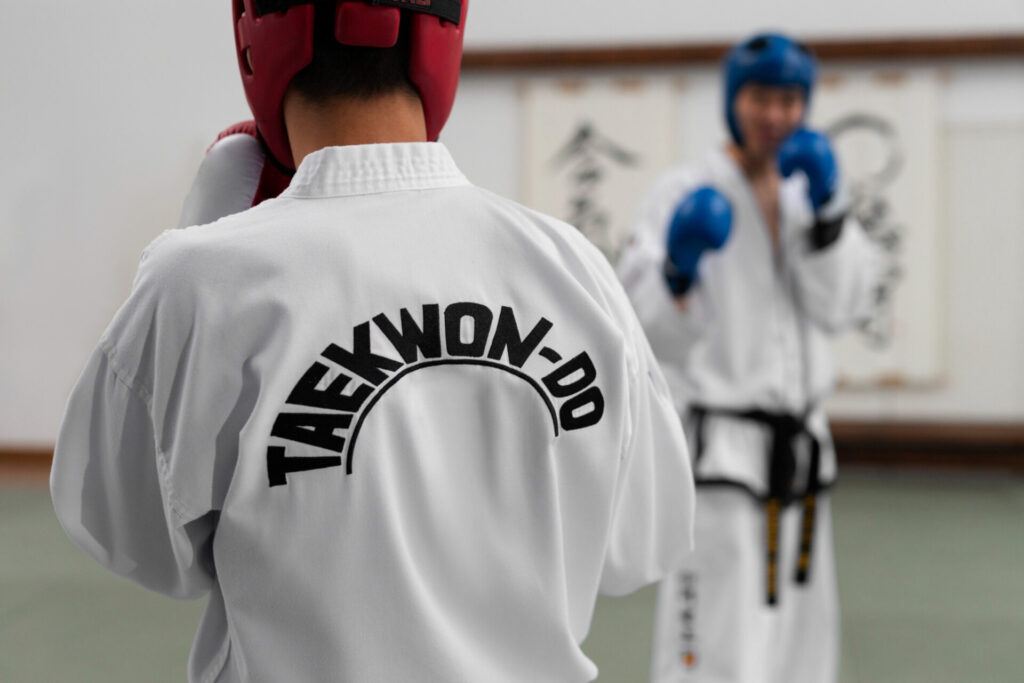
Many people join their first Taekwondo class not to win competitions or earn a black belt. Most likely, they want to feel stronger and more confident.
Picture this: you’re walking home after work or school, and it’s dark. Suddenly, you hear footsteps behind you. Or picture your child not knowing how to respond to bullies at school. We wish we had learned self-defense techniques. Powerful kicks would help, or just staying calm and alert.
This is why many people consider Taekwondo as their choice for self-defense training. However, the question remains,”Will Taekwondo really help me if I need to protect myself?” The answer may surprise you once you read this article.
So, let’s explore what this martial art really teaches and how those lessons can be applied in real-life settings.
What is Taekwondo?
Taekwondo is an unarmed martial art that began in Korea. It teaches students how to use their hands and feet for kicking, striking, blocking, and self-defense. The name “Taekwondo” means “the way of the foot and the fist.” It was officially adopted in 1955. Today, it is one of the most popular martial arts in the world and is practiced by people of all ages.
Taekwondo was influenced by older Korean fighting traditions such as Taekkyon. Over time, the traditional techniques were combined with modern methods that became the Taekwondo we know today. Alongside powerful kicks, it teaches important life skills such as respect, discipline, self-control and perseverance.
How Effective is Taekwondo for Self-Defense?
Taekwondo can help with self-defense, but how well it works depends on the situation. Real-life encounters can be unpredictable, and no martial art works perfectly every time. While training and staying calm can help, awareness and good judgment are just as important.
To better understand its effectiveness, it helps to look at how Taekwondo may be used in common self-defense situations.
Taekwondo can help when facing an aggressive stranger. It creates distance, blocks attacks, and offers a way to escape safely. If there are multiple attackers, the goal is not to fight everyone but to create space and escape.
In tight spaces like elevators or hallways, students should use simple strikes, movement, and awareness. Large kicking techniques are not practical here. When facing a larger opponent, speed, timing, and technique can be more helpful than strength alone.
In the end, Taekwondo is not about winning every fight. It’s about being aware, making smart choices, and handling tough situations.
The Advantages of Learning Taekwondo for Self-Defense
Taekwondo has several benefits that can help in self-defense situations. Taekwondo won’t prepare you for every threat, but it builds skills. Students gain physical strength, mental focus, and confidence. These traits help them stay safe.
Teaches distance management and footwork
One of the most important self-defense skills is knowing how to manage distance. Taekwondo teaches students to move quickly, stay balanced, and keep space between themselves and the threat.
Strong footwork can also create a chance to escape. If a stranger approaches aggressively, move backward or to the side. This can buy you time to escape and get help.
Develops speed and reaction time
A quick reaction to an attack may give you the chance to break free. Taekwondo training focuses on quick movements, drills, and partner exercises. These elements boost your reaction time in unexpected situations.
In self-defense, awareness is important. It lets you see danger quickly.
Builds confidence underpressure
Confidence can make a big difference in a stressful situation. Through training, students learn to stay calm, focused, and in control under pressure. This confidence can help them think clearly and make better decisions.
In real life, staying calm may help you avoid panic. This lets you look at the situation and choose the safest action, such as leaving the area or calling for help.
Powerful strikes
Taekwondo is known for its strong kicks and strikes. Students learn how to use balance, timing, and proper technique to make their movements more powerful. Because the legs are often stronger than the arms, kicks can help create space from a threat.
For example, if someone is blocking your path, a well-placed strike may create enough space to escape and seek help. Taekwondo also teaches students to use these skills responsibly and only when necessary.
Physical conditioning
Self-defense situations can be physically demanding. Taekwondo helps improve strength, endurance, balance, flexibility, and coordination through regular training.
For example, students might do push-ups, sit-ups, and stretching. They can also practice kicking drills and simple footwork exercises. These activities build stronger muscles. They also improve flexibility for higher kicks and boost stamina. This way, students won’t tire easily.
Limitations
Taekwondo teaches us many useful skills. But just like any other martial arts, it is not perfect for every self-defense situation. Real-life situations are unpredictable. It can be fast, messy, or stressful sometimes. Knowing the limits of Taekwondo helps us remember that self-defense is about safety and smart choices.
Many Taekwondo techniques, like roundhouse and side kicks, need space to work well. In confined areas, it may be harder to use these techniques effectively. So, what you can do is to rely on quick thinking and simple movements.
Next, Taekwondo mainly focuses on techniques used while standing. If a person ends up on the ground, some of those techniques may not work as well. This is why self-defense is about more than physical skills. Staying alert, avoiding danger, and escaping safely are key ways to protect yourself.
How to Make Taekwondo More Effective for Self-Defense
Taekwondo gives a strong foundation for self-defense. However, learning extra skills can make students feel more prepared for real-life situations.
One way to improve self-defense skills is through cross-training. Learning other martial arts helps students face different situations, like close-range and ground defense. Scenario-based training is also helpful because it allows students to practice how they might respond in real-life situations.
Learning how to escape common grabs is another useful skill. Knowing how to break free from a wrist grab or similar hold can create a chance to move away and stay safe.
When you mix physical skills with awareness, confidence, and good judgment, Taekwondo works better for self-defense. It becomes an even stronger part of a self-defense plan.
Final Word
Taekwondo is great for self-defense. It teaches key skills such as movement, distance control, speed, awareness, and confidence.
However, Taekwondo is not enough on its own for every situation. It works better when paired with realistic sparring and self-defense practice. Also, learning to handle situations like close-range grabs helps. Since real-life situations are unpredictable, no martial art can prepare someone for everything.
Overall, Taekwondo is a valuable part of self-defense training. Awareness, discipline, and confidence are your greatest self-defense tools. If you’re ready to reach your full potential, take the next step with our Taekwondo classes in Henderson, NV. We forge champions on and off the mat.